A recent commentary published by Teppo Turkki on his blog “Itätuulen tuomisia” challenges the European Union’s current trajectory, warning that without radical reforms, the continent risks being marginalized into a “managed periphery.” The focus is on streamlining decision-making and breaking away from security dependence on the United States.
Increasingly emphatic voices in European security and economic discourse are demanding that the EU “wake up” to the new geopolitical reality. Turkki’s recent analysis fits into this continuum, painting a picture of a Europe facing an existential choice.
The core of the argument is stark: The post-WWII era, during which Europe could outsource its security to the United States and rely on a liberal, rules-based order, is irrevocably over.
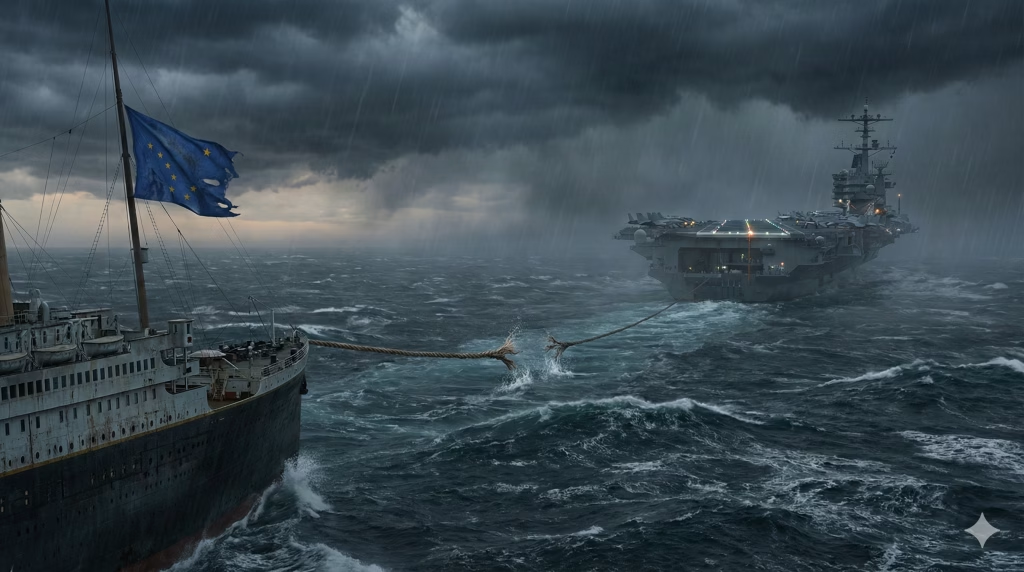
The text does not predict a sudden collapse or war for Europe, but something perhaps harder to combat: a slow fade into irrelevance. The threat scenario is one of Europe turning into an “open-air museum”—a continent that offers stability and markets, but has no say in how the world’s major issues are decided.
The Decision-Making Paradox
The analysis’s sharpest criticism is directed at the EU’s internal structures. Teppo Turkki highlights an “institutional paradox”: The EU attempts to project itself as a global superpower, but internally it continues to operate as a fragmented coalition.
The requirement for unanimity in foreign and security policy is identified as particularly problematic. The text argues that the current model allows individual member states—or external actors through them—to paralyze the entire Union’s decision-making.
The proposed solutions are harsh: a move to qualified majority voting in foreign policy and automatic financial sanctions for member states that violate the rule of law. The message is clear: in the current global situation, internal fragmentation is a security risk.
Security and Economy Merge
Another central thesis concerns the relationship between the economy and security. The analysis rejects the idea that trade policy and security policy are separate islands.
The vision calls for a “security exception” to fiscal discipline. This would mean Europe beginning to invest massively in strategic autonomy—defense industries, artificial intelligence, 6G networks, and clean energy—without being constrained by traditional budget rules.
The goal is set for a Europe that, by the 2030s, is capable of responding to conventional military threats on its own soil without decisive American assistance. This is a significant deviation from the current NATO doctrine, which relies heavily on the transatlantic link. Turkki views the waning or uncertainty of US support (referencing, among other things, Trump’s politics) as a permanent trend, not a temporary glitch.
An Architect’s Role for Finland
The analysis does not leave Finland as a bystander. Finland’s role is outlined in the text as the “Northern Hub.”
According to the writer, mere NATO membership is not enough; Finland should take an active role as an architect of the northern defense infrastructure and as a guarantor of security of supply. Furthermore, a role larger than its size is envisioned for Finland as a technological pioneer in areas such as cybersecurity and the bioeconomy.
Summary: The Choice is Now
The undertone of the commentary is one of sounding the alarm bells. It challenges the reader to consider whether Europe is too slow and rigid to survive the competition with China, the rising Global South, and its own internal conflicts.
If the analysis’s premises hold true, Europe’s current “business as usual” attitude is not merely insufficient, but a dangerous strategy that will inevitably lead to the marginalization of the continent.