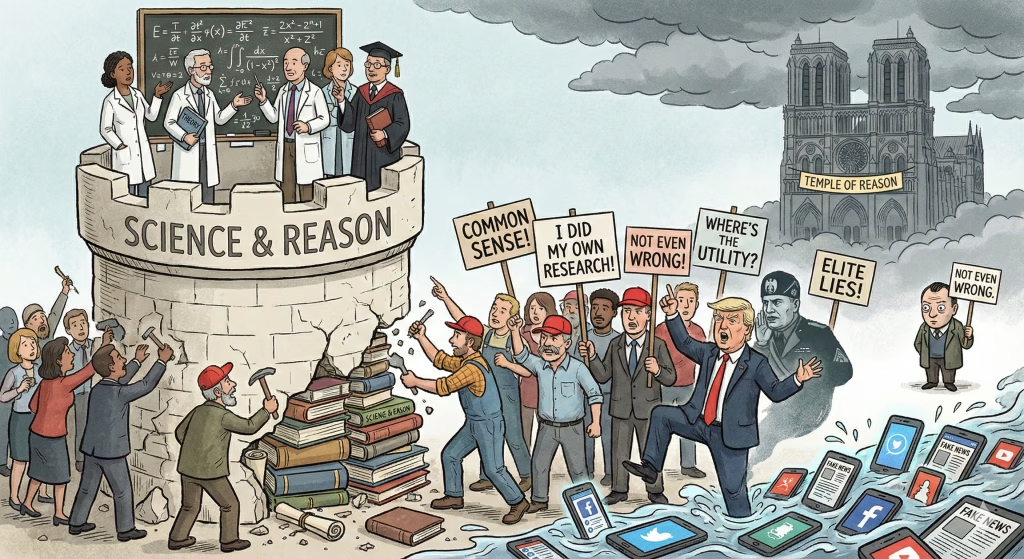
“Not Even
Wrong“
Based on the analysis by Professor Kari Enqvist.
Anti-science sentiment has shifted from academic debates to a political weapon. It is no longer a question of valid disagreement, but a descent into irrationality where facts are ignored in favor of “street smarts” and immediate utility.
The Core Thesis
- ✔ The Shift: From Left-wing theories to Right-wing populism.
- ⚠ The Driver: Deep-seated anti-elitism and practical utility.
- ❌ The State: Arguments so incoherent they are “not even wrong.”
The Changing Face of Skepticism
Thirty years ago, attacks on scientific objectivity came primarily from a small group of left-wing academic social scientists (e.g., the “Sokal Hoax” era). Today, the battlefield has shifted entirely. The new “science war” is waged by the political Right, driven not by theory, but by populist anti-elitism.
“The warriors of the new science war do not populate universities… they are practical people.”
Source of Anti-Science Sentiment
Comparison of dominant ideological sources over time
Who are the “Practical People”?
Unlike the academic debates of the past, modern skepticism arises from professions grounded in “practicality.” These groups often view scientific theorizing as “useless speculation” unless it yields immediate profit or utility, mirroring the anti-intellectualism seen in historical authoritarian regimes.
Key groups identified by Enqvist as drivers of the current right-wing science criticism.
Anti-Elitism
A historical resentment of the “elite,” drawing parallels to the French Revolution and Mussolini’s Italy. Experts are viewed with suspicion.
Demand for Utility
“Stop useless speculation!” The belief that science is only valid if it produces immediate, practical benefits (money, products).
Common Sense Fallacy
The arrogant belief that complex phenomena (like Relativity) can be judged by “street smarts” or lay intuition.
The “Not Even Wrong” Spectrum
Physicist Wolfgang Pauli famously described arguments so incoherent they couldn’t even be proven false as “not even wrong.”
Enqvist argues we have reached the “final shore of anti-elitism,” where rationality is abandoned. Internet comments are weighed equally against decades of research.
How to read the chart:
Top Right: Valid Science (High Logic, High Evidence).
Top Left: Scientific Errors (Logical, but disproven).
Bottom: “Not Even Wrong” (The Danger Zone – Illogical, no evidence, purely ideological).
Universities
🎓The domain of basic research. Their responsibility is to understand reality, question theoretical frameworks, and expand human knowledge, regardless of immediate profit.
Markets & Companies
🏭The domain of application. They take scientific possibilities and productize them. This is “R&D” or product development, where utility is the primary metric.
Read the original column in Finnish here.