Executive Summary
Professor Kari Enqvist’s column addresses the growing global trend of anti-science sentiment. He argues that while science criticism formerly originated from the academic left, the current “war on science” is driven by the political right and is rooted in anti-elitism. This modern opposition is characterized by a demand for immediate utility and a profound misunderstanding of the scientific method, resulting in arguments that are often irrational or “not even wrong.”
Key Factual Points
1. The Shift from Left to Right
- Past (approx. 30 years ago): Criticism of natural sciences largely came from a small group of left-wing academic social scientists (e.g., in the US). This “rebellion” failed due to a lack of understanding of the subject matter.
- Present: The current “science war” is waged by the political right. These critics are typically not university insiders but “practical people” (engineers, lawyers, economists).
- Political Impact: In the US, this sentiment reached the highest levels of administration (e.g., under Donald Trump), leading to university budget cuts and skepticism regarding vaccines and climate change.
2. Roots in Anti-Elitism and Utility
- Anti-Elitism: Current anti-science sentiment is closely linked to historical anti-elitism (parallels drawn to the French Revolution, the Soviet Union, and Mussolini’s Italy).
- The “Utility” Trap: Enqvist notes that authoritarian regimes (like Mussolini’s) only valued science if it provided immediate practical benefits. Modern right-wing populism echoes this, demanding that science produce direct utility and dismissing theoretical research as “useless speculation.”
3. The Collapse of Rational Argument (“Not Even Wrong”)
- The Sokal Hoax: In the 90s, physicist Alan Sokal exposed the misuse of scientific concepts by the academic left. Enqvist argues the modern right now shares this “conceptual confusion.”
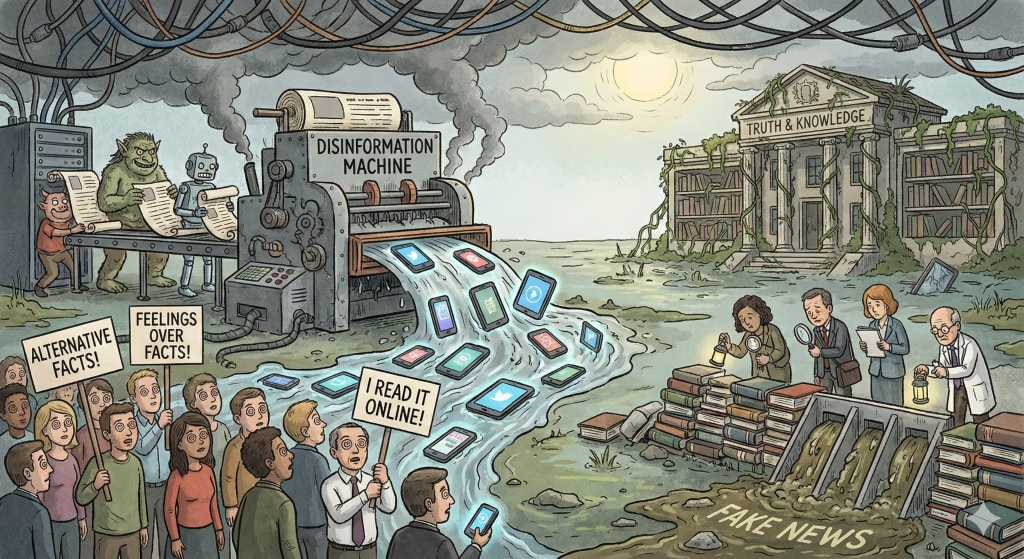
- Post-Rationality: We have reached a point where rationality is not even simulated. Internet claims are treated as equivalent to extensive peer-reviewed research.
- “Not Even Wrong”: Enqvist cites physicist Wolfgang Pauli’s phrase to describe claims that are so incoherent or detached from reality that they cannot be rationally debated or proven incorrect. Much of modern science criticism falls into this category.
4. Misunderstanding the Scientific Method
- Disagreement is Essential: Critics often view disagreement among researchers as a weakness. In reality, proving others wrong is a core, celebrated part of the scientific process.
- Theory vs. Fact: Critics demand “facts” without “theorizing,” failing to understand that pure observations do not exist; facts are always relative to a theoretical framework.
- Common Sense Fallacy: Enqvist argues that common sense is insufficient for evaluating complex science (e.g., Einstein’s General Relativity defies common sense). Using “street smarts” to critique high-level physics is portrayed as arrogant.
5. Institutional Roles
- Universities vs. Markets: The column concludes by clarifying roles:
- Universities are responsible for basic research and understanding reality.
- Companies/Markets are responsible for generating practical utility and product development (R&D).